Project
Electric Go-Kart Conversion
Repaired an electric go kart by wiring the motor controllers, 48V battery, throttle, and power distribution from scratch on a dual-motor chain-drive setup.
Timeline · March 2024 — December 2024
GitHub: N/A
Summary
This was a class project where we took an existing go-kart frame and converted it to a fully electric drivetrain. My role was the electrical system where I designed and wired the full power distribution architecture, installed and configured the motor controllers, soldered connections throughout the chassis, and integrated the throttle control with the 48V battery pack and dual motors. The kart drove successfully at the end of the project.
The Build
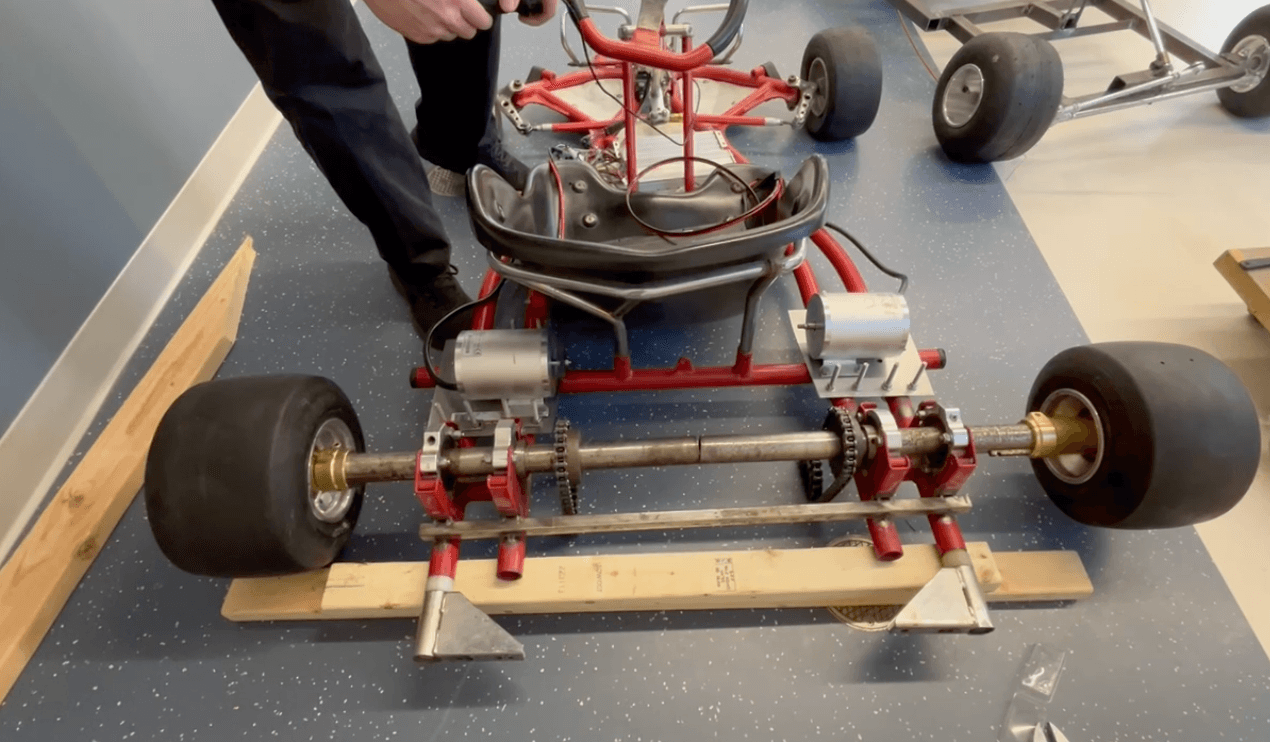
The kart uses two DC motors mounted to the rear of the frame, each driving the rear axle through a chain-and-sprocket setup. The 48V battery pack sits behind the seat and feeds both motors through motor controllers that handle speed regulation and current delivery.
My job was making all of that talk to each other. That meant designing the wiring layout to route power from the battery through the controllers to the motors, wiring the motor control units to handle signal and power connections between the throttle input, controllers, and motors, and making sure the high-voltage and low-voltage sides of the system were properly separated and protected. Everything was hand-soldered and routed within the tight confines of the kart's tubular steel frame.
Challenges
Working with a 48V system on a metal chassis meant every connection had to be solid and insulated properly. Fitting all the electrical components into a chassis that was originally not designed for a dual motor setup was challenging, and required cutting and welding the frame.
The motor controllers also needed configuration and tuning to match the throttle input range to a smooth acceleration curve rather than just slamming full power on any throttle input.
What I Learned
This project also gave me hands-on experience with power electronics at a scale bigger than anything I'd worked with before going from 5V microcontroller circuits to 48V motor drive systems is a meaningful jump. Additionally, it showed me the joy of completing something which could lead to a lot of fun.