Project
PEM Hydrogen Fuel Cell — Energy Cycle Demonstration
Demonstrated a complete hydrogen energy cycle from electrolysis to fuel cell power generation, and tested how voltage, temperature, and solar input affect efficiency.
Timeline · May 2023 — August 2023
GitHub: N/A
Summary
This project explored the full hydrogen energy cycle using a Proton Exchange Membrane (PEM) system. The idea is straightforward: use electrical energy to split water into hydrogen and oxygen (electrolysis), then feed that hydrogen into a fuel cell to generate electricity back—powering a small fan motor as the load. I tested the system with both a benchtop power supply and a solar panel, measuring how input voltage, water temperature, and charge time affected hydrogen production rate, cell resistance, and overall efficiency.
How It Works
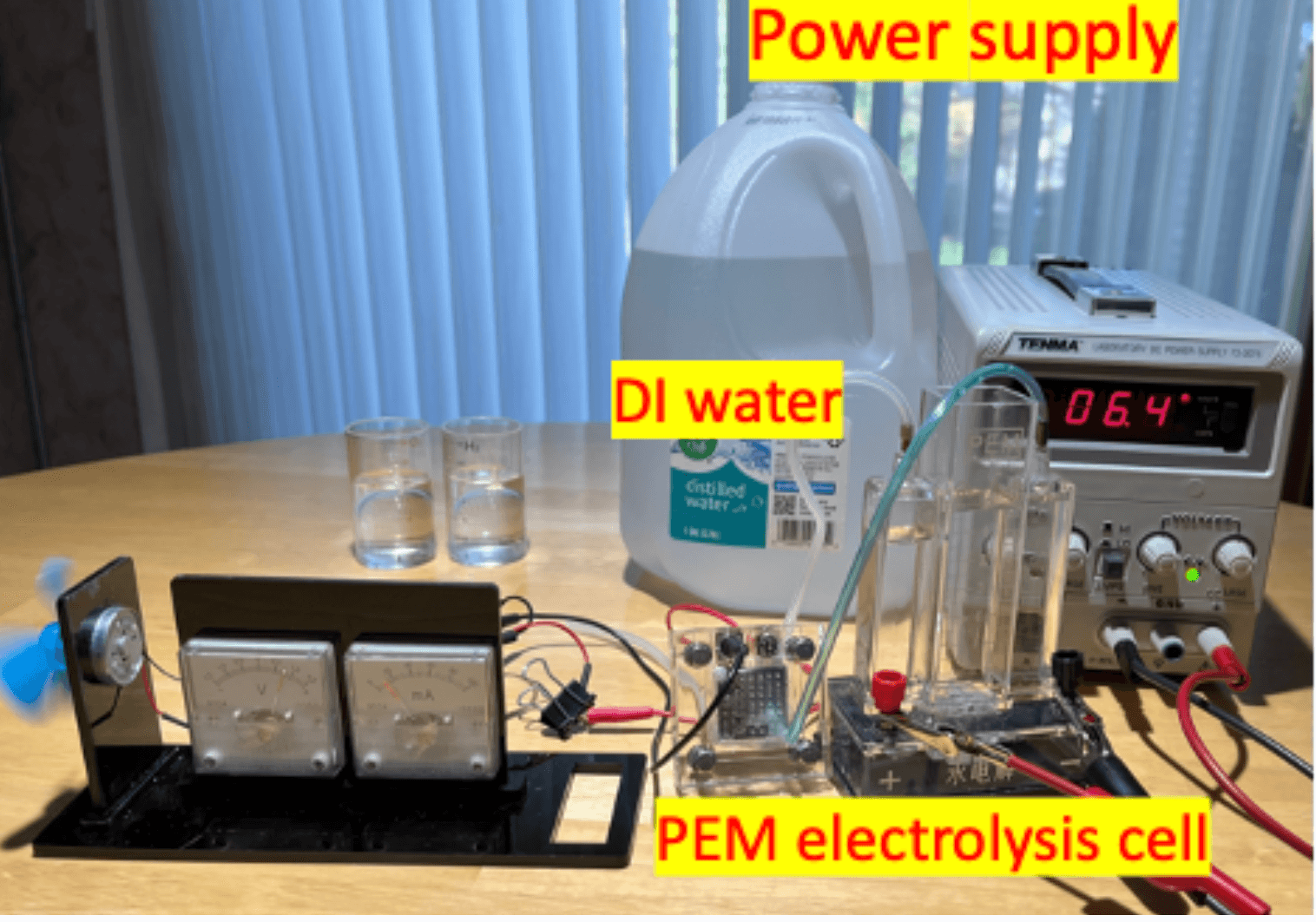
The system has two main stages. First, a PEM electrolysis cell splits deionized water into hydrogen and oxygen using electrical energy. The hydrogen gets collected in a graduated cylinder so you can measure the volume produced over time. Second, that hydrogen is fed into a separate 5 cm² PEM fuel cell, which runs the reaction in reverse, combining hydrogen and oxygen to produce electricity. The fuel cell's output was measured across different resistive loads (5–25 ohm) using a multimeter to characterize its voltage-current relationship.
I also swapped the power supply for a 6V solar panel to see if the whole cycle could run off solar energy alone — making it a fully renewable loop from sunlight to hydrogen to electricity.
Key Findings
The electrolysis side had some interesting behavior. Hydrogen production rate increased with input voltage, going from essentially nothing at 3V up to about 300 ml/hr at 6–7V. But efficiency peaked around 33% at 6V and then dropped off — pushing more voltage past that point just wasted energy as heat rather than producing more hydrogen.
Temperature had a big effect. Raising the water temperature from 23°C to 38°C nearly doubled the production rate (150 to 300 ml/hr) and pushed efficiency from ~25% up to ~39%. Warmer water lowers the cell's internal resistance because the membrane becomes more conductive and the electrochemical reaction kinetics speed up.
Cell charge time mattered too. A dry membrane started at ~46 ohms resistance but dropped to ~17 ohms after about 30 minutes of hydration, then plateaued. So the cell needed to be pre-soaked before it performed well.
On the fuel cell side, the open circuit voltage came in at 0.93V against a theoretical 1.23V, giving a voltage efficiency of about 75.6%. As you increased the current draw by lowering the load resistance, the voltage dropped — classic polarization behavior from activation losses and ohmic resistance in the membrane.
The solar-powered cycle worked but was finicky. The 6V panel produced a fuel cell output of 0.9V at 15 mA — enough to spin the fan, but heavily dependent on sunlight consistency.
Challenges
The biggest limitation was measurement accuracy. Without a potentiostat, I had to characterize the fuel cell's I-V curve by manually swapping resistors and reading a multimeter. The solar testing was also inconsistent because cloud cover and temperature fluctuations made it hard to get repeatable results outdoors.
What I Learned
This was one of my first hands-on projects that combined electrical measurements, electrochemistry, and data analysis. Plotting the efficiency curves and seeing the voltage-temperature-resistance relationships play out in real data was what first got me interested in how energy systems work at the hardware level.